Festival Dates: 18 – 20 February 2027
Location: Sam Sand Dunes & Jaisalmer Fort, Jaisalmer, Rajasthan, India
Organised by: Rajasthan Tourism Development Corporation (RTDC)
The History Behind the Desert Festival
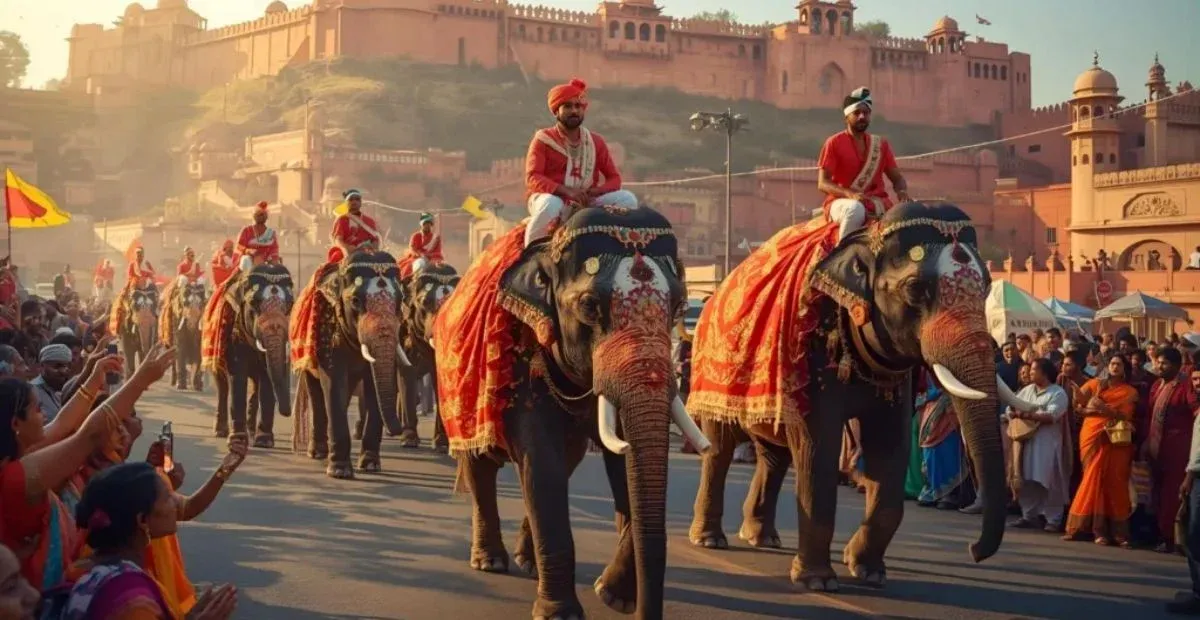
The Jaisalmer Desert Festival, locally known as Maru Mahotsav, is Rajasthan’s grandest cultural celebration. Held every February over three days on the golden dunes of the Thar Desert, it brings together camel races, Kalbeliya dance, folk music, turban-tying contests, and the iconic Moustache Competition, all framed against the 800-year-old Sonar Quila (Jaisalmer Fort).
In 2027, the festival runs 18–20 February, culminating on the night of the full moon (Poornima) with a moonlit folk concert at Sam Sand Dunes.
The Legend of Jaisalmer’s Founding
The city itself was born from prophecy. Hindu mythology holds that Lord Krishna told the Pandava prince Arjun that a descendant of the Yaduvanshi clan would one day establish a kingdom on the Trikuta Hill. That promise was fulfilled in 1156 CE when Rawal Jaisal, a valiant Bhati Rajput warrior, founded the city that still bears his name — Jaisalmer. Every year, in the Hindu month of Magh (February), the people of Jaisalmer celebrate that founding moment with the energy of a city remembering its own legend.
The Modern Festival
While the cultural roots run deep, the Desert Festival in its organised, large-scale form is a product of the late 20th century. The Rajasthan Tourism Development Corporation (RTDC) launched the structured festival to promote Rajasthan’s heritage tourism and provide an international-facing platform for local artists, craftspeople, and performers who otherwise struggle to reach wider audiences. Today it is one of the most photographed and internationally attended regional festivals in India drawing visitors from Europe, Japan, Australia, and the Americas alongside thousands of domestic tourists.
The festival ends on Poornima (full moon), which in 2027 falls on 20 February, making the final night at Sam Sand Dunes a once-in-a-year spectacle of firelight, folk music, and moonrise over open desert.
What Does the Desert Festival Offer? A Day-by-Day Guide
The three days of Maru Mahotsav are dense. Here’s how the experience typically unfolds, so you can plan what not to miss.
Day 1 — Culture, Craft & the Opening Procession
The festival opens with a ceremonial procession from Jaisalmer Fort toward the festival grounds. Local artists, decorated camels, folk musicians, and performers fill the narrow sandstone lanes — it feels like the entire city has stepped into costume.
Key highlights on Day 1:
Puppetry (Kathputli) Rajasthani puppetry is not a children’s sideshow — it’s a storytelling tradition stretching back centuries, used historically to narrate battles, romances, and mythological tales in villages with no written media. Watch the puppeteers’ fingers work with a speed that seems impossible. These same families often earn the majority of their annual income during festival season; buying a puppet from them is one of the most meaningful souvenirs you can carry home.
Snake Charming One of the oldest folk art traditions in western Rajasthan, snake charming performances — while controversial in modern animal-welfare discussions — remain part of the festival’s cultural display. Practitioners come from hereditary communities who have maintained this craft for generations.
Kalbeliya Dance UNESCO recognised Kalbeliya folk songs and dance as an Intangible Cultural Heritage of Humanity in 2010. The performers belong to the Kalbeliya tribe — traditionally snake handlers — and their swirling black skirts, sinuous movements, and hypnotic rhythms are unlike any dance form you’ll see elsewhere in India. Do not miss the evening performance; it is the most attended event of Day 1.
Day 2 — Competition Day
Day 2 is where the festival’s most distinctive and photogenic events take place. Arrive early at the main festival ground — the crowds are real.
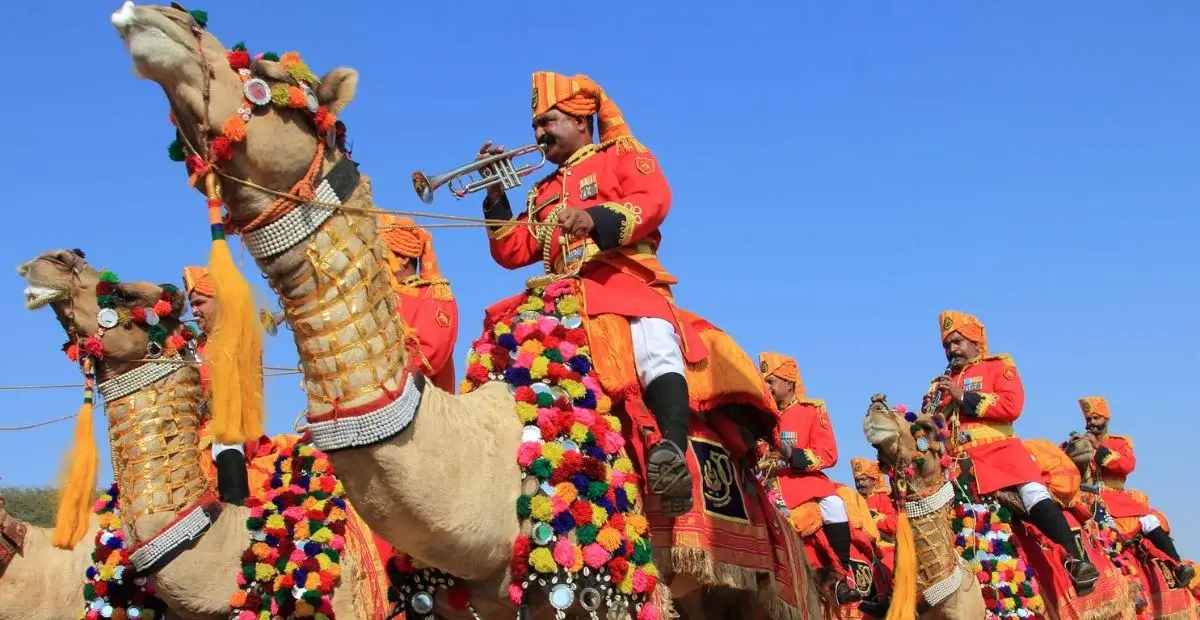
Camel Race: The most anticipated sporting event of the festival. Camels adorned with coloured embroidery and mirror-work accessories line up for a flat-out sprint across the dunes. The roar of the crowd, the thunder of hooves on sand, and the sheer improbability of a camel at full gallop makes this a genuinely thrilling spectacle.
Camel Polo: This is not horse polo with camels substituted in — it is an entirely different game. Played by BSF (Border Security Force) jawans who train their camels specifically for this event, camel polo moves at a slower, more strategic pace. It remains one of the most unique sporting experiences in India.
Turban Tying Competition (Safa Bandi): A turban in Rajasthan is not just a piece of cloth. Its style, colour, and draping method communicate caste, region, occasion, and social status. In the competition, participants — including many international tourists who join voluntarily — are judged on technique and elegance. The moment a German or Japanese tourist attempts a Rajasthani safa is always the crowd’s favourite minute of the day.
The Longest Moustache Competition: Only in Rajasthan. Rural men who have spent years — sometimes decades — cultivating their moustaches compete for the title. Some entrants have moustaches exceeding two feet in length, waxed and curled with considerable pride. It’s theatrical, joyful, and thoroughly Rajasthani.
Maru-Shri (Mr. Desert): Local men dress in full traditional Rajasthani attire — dhoti, embroidered jacket, decorated turban — and compete for a title that celebrates heritage over modernity. Think of it as a pageant that is entirely about cultural pride, not vanity.
Panihari Matka Race: Women dressed in traditional ghaghra-choli and silver jewellery race while balancing clay water pots on their heads — a nod to the centuries-old practice of water-carrying in desert communities. It’s competitive, graceful, and visually stunning.
Acrobatics: Trained acrobats — many from nomadic Nat communities — perform jaw-dropping feats on foot and on camelback. Women from rural communities perform the Matka dance simultaneously with stacks of clay pots balanced on their heads. The combination of skill, balance, and performance takes years to master.
Gair & Fire Dancing: As the sun sets on Day 2, fire performers take the stage. Local stuntmen breathe fire, dance with flaming rods, and perform acts that will feel genuinely dangerous because, in part, they are. This is not a sanitised theme-park experience — it is folk daring, practised and hereditary.
Day 3 — The Grand Finale at Sam Sand Dunes
The final day moves the entire festival to the Sam Sand Dunes, approximately 45 kilometres from Jaisalmer city. This is the most spectacular setting of the three days — open desert, towering dunes, and the full moon rising over the Thar.
Air Force Display Indian Air Force aircraft perform a flyover and aerial display above the dunes — a dramatic contrast of military precision against the ancient desert landscape.
Parachuting & Cricket Military parachutists descend onto the dunes in a crowd-pleasing display, followed by a cricket match that offers a lighter, festive energy before the evening concert.
Rajasthani Folk Music Concert The festival’s emotional high point. As darkness falls and the full moon rises, some of Rajasthan’s finest folk musicians — including Manganiyar and Langa performers — play under an open sky. The Sonar Quila glows amber in the distance. The combination is difficult to describe and impossible to forget.
Fireworks The festival closes with a fireworks display that lights the desert sky, marking the end of Maru Mahotsav 2027.
Practical tip: Book your transportation to Sam Dunes in advance on Day 3. Every taxi and jeep in Jaisalmer fills up fast. Your hotel or desert camp can arrange this — confirm it when you check in.
5 Things to Do in Jaisalmer Beyond the Festival
If you’re building a 4–5 day itinerary around the festival, here’s where to spend the non-festival hours.
1. Jaisalmer Fort (Sonar Quila) — UNESCO World Heritage Site the only fully inhabited fort in the world. Walk through its narrow lanes, visit the Jain Temples within the fort complex, and watch the golden sandstone turn amber at dusk. Entry is free; the Jain temples have a small fee. Best visited in the morning before crowds build.
2. Gadisar Lake Built in 1367 by Maharawal Gadsi Singh as a water conservation reservoir, this serene lake is surrounded by temples, ghats, and bird life. Boating is available (approximately ₹50–₹100 per person for a pedal boat). Best experienced at sunrise when the light on the water is extraordinary.
3. Desert National Park Spanning 3,162 sq. km, this is one of the largest national parks in India and one of the few places in the world where you can see the Great Indian Bustard — a critically endangered bird. The park also shelters desert foxes, desert cats, and Chinkara (Indian gazelle). A jeep safari through the park takes 2–3 hours and costs approximately ₹500–₹800 per person with a guide.
4. Desert Safari — Camel or Jeep A camel safari from Jaisalmer to Sam Sand Dunes is the experience most visitors cite as their trip’s best memory. Jeep safaris (₹3,000–₹3,500 per vehicle) cover more ground faster. Camel safaris are slower and more meditative. Both can include a desert camping night — a genuine highlight, with Rajasthani folk music, a bonfire dinner, and a morning desert sunrise.
5. Patwon Ki Haveli & Nathmal Ki Haveli Jaisalmer’s merchant havelis are masterclasses in sandstone carving. Patwon Ki Haveli (a cluster of five mansions built in the 19th century) has the most elaborate jharokhas (overhanging windows) and fresco work in the city. Nathmal Ki Haveli has a striking asymmetrical facade — each half was carved by a different master craftsman without reference to the other, yet they match almost perfectly.
How to Reach Jaisalmer for Desert Festival 2027
The festival draws enormous crowds. Plan and book at least 3–4 months in advance — hotels, desert camps, and transport all surge in price and availability during February.
| Mode | Details | Travel Time | Approx Cost |
| By Air | Jaisalmer Civil Airport (JSA) has direct flights from Delhi and Jaipur. Check IndiGo and Air India for 2027 schedules. | 1 hr from Delhi | ₹3,500–₹8,000 one-way |
| By Train | Jaisalmer Railway Station is 1.8 km from the city centre. The Delhi–Jaisalmer Express and Jaipur–Jaisalmer trains are most used. Book on IRCTC 90 days ahead — berths sell out fast for February dates. | 16–18 hrs from Delhi | ₹600–₹2,500 |
| By Road from Jodhpur | Jodhpur is the nearest major hub (280–295 km). AC buses (RSRTC Volvo), private taxis, and self-drive all work well. NH11 is in good condition. | 4.5–5 hrs | ₹500–₹4,000 depending on mode |
| By Road from Jaipur | Approximately 570 km via Jodhpur. Overnight bus services available. | 9–10 hrs | ₹900–₹5,000 |
Festival Season Tip: Jaisalmer’s accommodation options — from heritage hotels inside the fort to luxury desert camps at Sam — fill completely for festival dates. Book your stay before October 2026 if possible. Desert camps at Sam Sand Dunes offer the most immersive experience for the final night of the festival.
Practical Information for Desert Festival 2027
| Festival Name | Jaisalmer Desert Festival / Maru Mahotsav 2027 |
|---|---|
| Dates | 18 – 20 February 2027 |
| Main Venues | Jaisalmer Fort (Day 1–2) → Sam Sand Dunes (Day 3) |
| Organised by | Rajasthan Tourism Development Corporation (RTDC) |
| Entry | Most events are free to attend; some ticketed shows apply |
| Best Time to Arrive | 15–16 February to settle in and explore the city before crowds peak |
| Weather in February | Days: 18–24°C (warm, sunny). Nights: 5–10°C (cold — carry layers) |
| Currency | Most festival stalls now accept UPI / credit cards. ATMs available in the city. |
| Medical | State-deployed medical vans are stationed at the festival grounds |
| Nearest Airport | Jaisalmer Civil Airport (JSA) — direct flights from Delhi, Jaipur |
Conclusion
The Jaisalmer Desert Festival is not a tourist recreation of Rajasthani culture — it is Rajasthani culture, concentrated into three days of colour, competition, and music under an open desert sky. Whether you are drawn by the camel races, the fire dancing, the folk concerts, or simply the sight of Sonar Quila glowing gold at dusk, Maru Mahotsav 2027 is the kind of experience that stays with you long after the desert dust settles.Plan your Desert Festival trip with Delightful India Holidays — tailor-made Rajasthan packages built around the February 2027 festival dates. Also book the best Rajasthan Tour Packages from Delight India Holidays.